Retirement guide
Retirement withdrawal strategies
A retirement withdrawal strategy defines how portfolio savings become spending and what changes when inflation, markets, or the household budget differ from the plan. This guide compares four approaches without treating any one method as a guarantee.

Reviewed for 2026
Retirement withdrawal strategies: a quick answer
A useful strategy answers three questions: how the first withdrawal is set, how later withdrawals change, and what event causes the plan to be reviewed. Fixed, percentage-based, guardrail, and bucket approaches answer those questions differently.
None of these methods can guarantee that savings will last. The planned retirement length, spending flexibility, outside income, inflation, taxes, fees, asset allocation, and timing of gains and losses still matter.
Separate the spending rule from the investment plan
A withdrawal rule determines how much leaves the portfolio. Asset allocation and rebalancing determine how the remaining savings are invested. Both decisions matter, but they are not the same decision.
Compare four retirement withdrawal approaches
The table describes the operating rule for each approach. It does not rank the methods or assign a recommended withdrawal rate.
| Approach | How the first withdrawal is set | What happens later | Main tradeoff |
|---|---|---|---|
| Fixed inflation-adjusted amount | Choose a dollar amount, then adjust that amount by the inflation rule. | Spending is comparatively stable, even when the portfolio balance changes. | Predictable spending can put more pressure on savings after weak returns. |
| Percentage of current balance | Withdraw a chosen percentage of the current portfolio balance. | The dollar withdrawal rises or falls as the portfolio value changes. | Savings are less likely to be forced below zero by a fixed withdrawal, but spending targets will fluctuate according to market conditions. |
| Spending guardrails | Set an initial withdrawal and rules for when spending will rise, pause, or fall. | Review the withdrawal rate and apply the documented adjustment rules. | Flexibility can respond to markets, but the household must be able to follow the reductions. |
| Bucket approach | Assign near-term spending and longer-term assets to separate time-based pools. | Fund retirement expenses from the near-term pool and define how or when it may be replenished. | The buckets can make near-term liquidity easier to plan, but they do not remove investment risks because the near-term bucket needs to be replenished. |
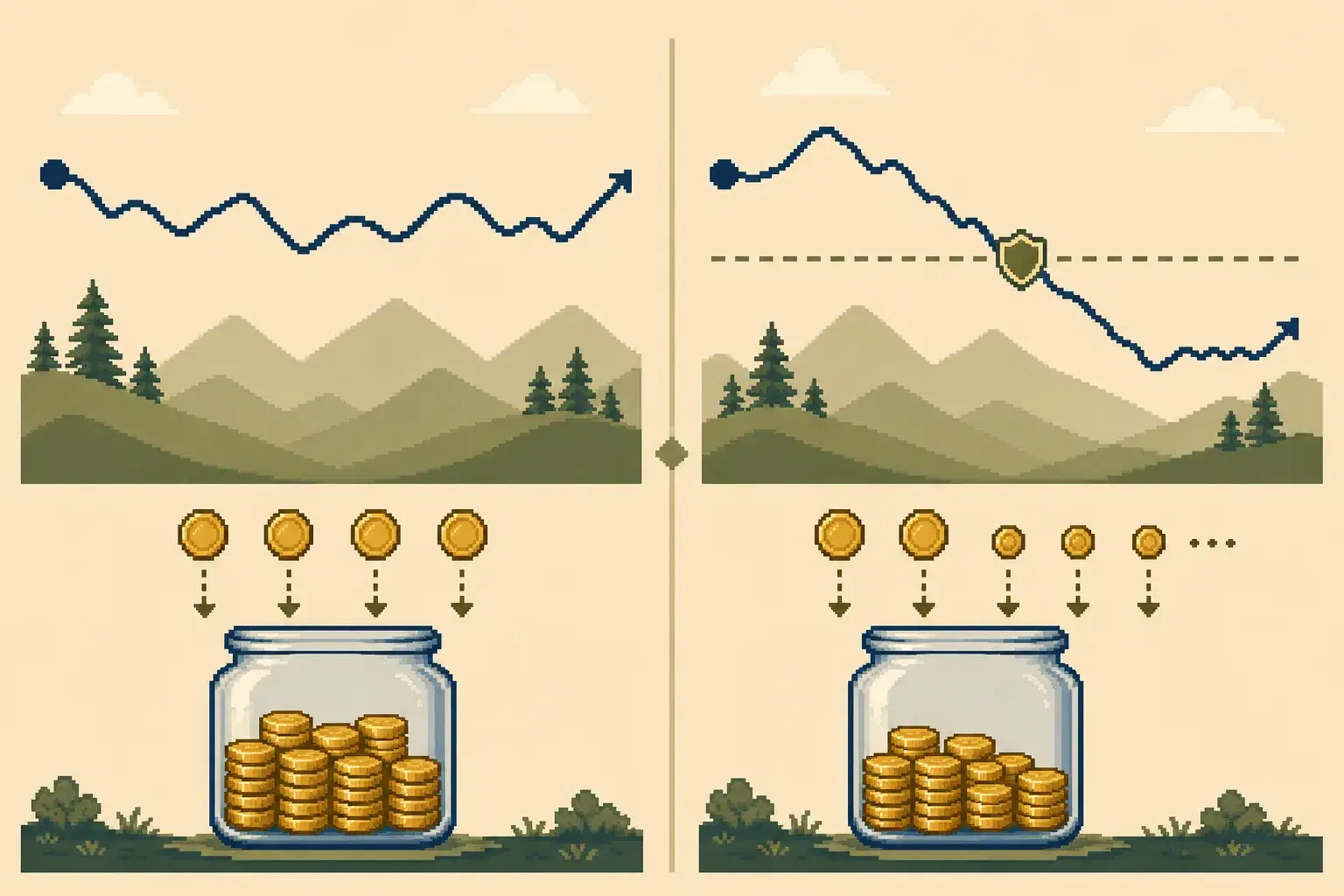
A bucket approach is primarily a way to organize assets and near-term liquidity. It still needs a spending rule, a replenishment rule, and a plan for what happens if longer-term assets lose value.
What the 4% rule does and does not mean
William Bengen's 1994 research tested inflation-adjusted withdrawals against historical US market periods. The commonly cited framework begins with roughly 4% of the starting portfolio in the first year, then adjusts that dollar withdrawal for inflation.
first-year withdrawal = starting portfolio × withdrawal rate
Historical survival in the periods studied is not a promise about a future retirement. The result depends on the study's historical data, portfolio assumptions, withdrawal timing, and retirement horizon. A different investment mix, longer retirement, taxes, fees, or spending path can produce a different result.
The 4% rule also differs from withdrawing 4% of the current balance every year. The historical framework adjusts the original dollar amount for inflation; a current-balance percentage recalculates the dollar withdrawal from the portfolio value each year.
Hypothetical example: 3%, 4%, and 5% spending inputs
Each calculator-generated scenario begins retirement at age 65 with $1,000,000 in savings and no further contributions. Annual spending equals 3%, 4%, or 5% of the starting balance. Every case uses a steady 5% nominal retirement return and 2.5% inflation.
annual spending input = $1,000,000 × withdrawal percentage
| Starting percentage | Annual spending input | First future-dollar withdrawal, age 65 to 66 | Estimated coverage |
|---|---|---|---|
| 3% | $30,000 | $31,519 | Beyond age 100 |
| 4% | $40,000 | $42,025 | Beyond age 100 |
| 5% | $50,000 | $52,531 | About age 92 |
These are deterministic calculator illustrations, not historical backtests or recommendations. The calculator applies the same return and inflation rate every year, excludes taxes, fees, outside income, and market volatility, and stops at age 100. “Beyond age 100” does not mean the savings last indefinitely.
Investment-return order can change the withdrawal outcome
A steady average return hides the order in which gains and losses occur. Losses early in retirement can be especially difficult when withdrawals continue, because fewer assets remain to participate in a later recovery.
Fixed spending may require selling more assets after a decline. Percentage-based spending falls automatically with the balance. Guardrails can call for a reduction, while a bucket plan may draw from near-term assets according to its rules. None removes the underlying market loss.
See the investment returns risk guide for an illustration of early and later losses.
Taxes, fees, account rules, and RMDs affect usable spending
A gross portfolio withdrawal is not always the amount available for household expenses. Taxes and investment or advisory fees can reduce the usable amount, while account-access rules determine when a distribution is permitted.
IRS guidance says many retirement account owners generally begin required minimum distributions at age 73, with account, employment, ownership, and beneficiary-specific rules. An RMD is a tax rule, not a statement that the required amount matches the household budget or a sustainable withdrawal strategy.
Keep tax-driven distributions, portfolio withdrawals, Social Security, pensions, and spending in one annual cash-flow inventory so the same dollars are not counted twice.
A practical process for reviewing withdrawals
- Separate essential spending from expenses that could change temporarily.
- Record recurring income and the years when each source begins or ends.
- Define the first withdrawal and the exact rule for later adjustments.
- Test lower returns, higher inflation, and a longer retirement without changing every input at once.
- Review taxes, fees, RMDs, liquidity, and household changes before using the updated amount.
Write down the adjustment rule before markets move
A statement such as “spend less after a bad year” is not an operating rule. Record what measure will be reviewed, what threshold triggers a change, and which spending can change.
Frequently asked questions
What is a retirement withdrawal strategy?
It is a documented method for deciding how much to take from savings, how often to adjust that amount, and how the plan responds when spending or investment results differ from assumptions.
Is the 4% rule guaranteed to last for 30 years?
No. It is a historical planning framework, not a guarantee. Taxes, fees, investment mix, inflation, retirement length, spending changes, and the order of returns can all change the outcome.
Does a percentage-of-balance withdrawal prevent depletion?
Withdrawing only a percentage of the current balance avoids demanding the same fixed dollar amount from a shrinking portfolio, but the resulting income may become too low for the planned budget.
Can this calculator model guardrails or buckets?
No. It applies one inflation-adjusted spending path and one steady annual return. Use it to compare spending inputs, not to reproduce rule-based adjustments, separate asset buckets, or variable market returns.
How often should a withdrawal plan be reviewed?
Review it at least when spending, income, taxes, investment allocation, market results, or household needs change. A strategy should specify which changes trigger a new calculation.
Sources and important limits
Reference links
This calculator provides educational estimates only and is not financial, tax, legal, or investment advice.